Main section
Contributing to a more resilient Web-PKI ecosystem with SwissSign’s CT Log
SwissSign is launching a Certificate Transparency (CT) Log: a public, tamper-evident record of every TLS certificate issued across the web. They make trust in the Web-PKI observable: domain owners, browsers and monitors can see what has been issued, verify it independently and react quickly if something is wrong. This post explains why Certificate Transparency matters, how CT Logs make certificate issuance visible and verifiable, and how SwissSign’s own log contributes to a more resilient Web-PKI ecosystem.
Where Certificate Transparency Comes From
The CA trust model has always had a blind spot: a certificate authority can be compromised, or simply make a mistake, and the resulting bad certificates can go unnoticed for months. That stopped being hypothetical in 2011, when the CA DigiNotar was breached and used to issue fraudulent certificates that went undetected for weeks.
Google engineers responded with a proposal to make certificate issuance publicly visible, not just publicly trusted. It was formalized as RFC 6962 in 2013. Chrome required CT for Extended Validation certificates starting in 2015, then extended that to every publicly trusted certificate in 2018. From that point on, CT stopped being optional.
It’s kept proving its worth since. In 2015, CT logs exposed a rogue Symantec certificate for google.com within hours. In 2024 and 2025, they exposed twelve unauthorized certificates a Croatian CA had issued for Cloudflare’s 1.1.1.1 service. More recently, in October 2026, CT data helped Google Chrome identify unauthorized certificates issued after attackers hijacked the .gh, .sl, and .as country-code domains, including ones for several well-known brands. This time the CAs weren’t at fault: the DNS had been tampered with, so the certificates looked legitimate at issuance. Whatever the cause, the outcome was the same: because every publicly trusted certificate is visible in a public log, domain owners, browsers and independent monitors can spot unauthorized issuance, not just the CA that issued it.
What is Certificate Transparency and how does it works?
A CT Log is a public, append-only ledger of TLS certificates. Each entry sits inside a Merkle tree, a cryptographic structure that lets anyone verify an entry is really there and that the log's history hasn't been rewritten after the fact. Remove or alter an entry and the math breaks, so nobody has to take an operator's word for it.
Four roles keep the CT-system running:
-
CAs and submitters issue certificates and send them to one or more logs.
-
Logs store those submissions and prove, cryptographically, that an entry is included and that the log's history stays consistent over time.
-
Monitors and auditors watch logs continuously, checking for certificates issued against domains they care about and verifying that logs are behaving correctly.
-
User agents (browsers and other CT-aware clients) enforce the system on the user's side, refusing to trust a certificate unless it carries enough valid SCTs — typically at least two, from independent logs.
In practice, that plays out as a sequence of interactions across the ecosystem:
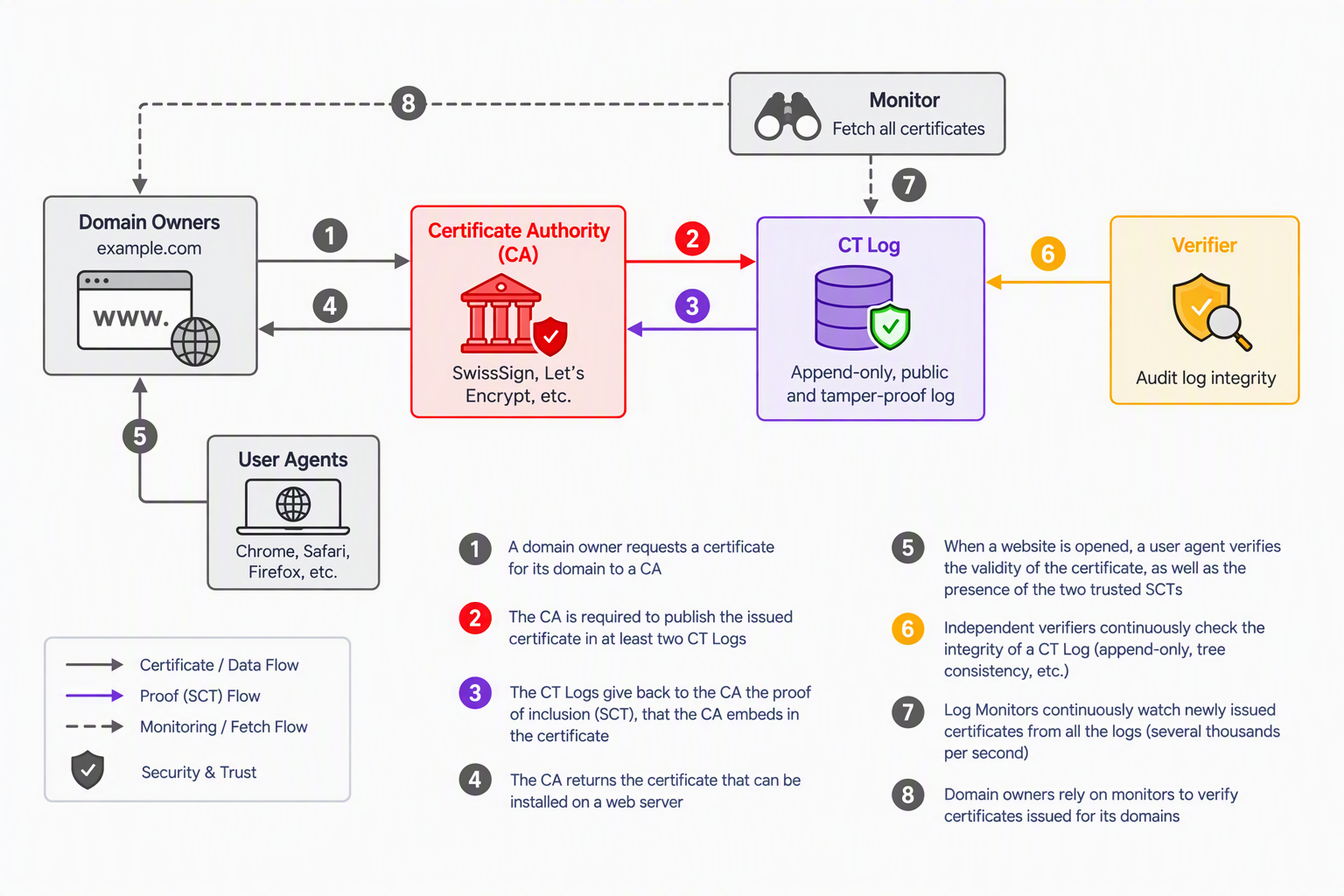
Image generated with AI using Microsoft Copilot.
That combination — public logs, independent monitors, and CAs required to submit everything they issue — is what lets any domain owner see every certificate issued for their domains, by any CA, whether they requested it or not. It's the foundation of how enterprises actually use CT Logs in practice, which we'll get into in our next post.
Contributing to the ecosystem
CT Logs only work as a system of checks if no single operator, or small handful of operators, becomes a single point of failure. Resilience needs genuine diversity: different operators, different infrastructure, different engineering choices, not just reslience ona small number of existing logs.
This is where SwissSign can make a meaningful contribution. As a publicly trusted european Certificate Authority, we already interact with CT Logs every day: every publicly trusted TLS certificate we issue must be submitted to CT Logs before browsers will accept it. CT is therefore not unfamiliar territory for us. Running a log ourselves is the logical next step: we are moving from relying on this infrastructure to helping operate it.
Right now, the CT ecosystem is supported by a relatively small number of logs and operators – 40 logs from just 11 operators – , most of them US-headquartered and often running on hyperscale cloud infrastructure. By launching our own CT Log, SwissSign ads an independent Swiss and European operator to this ecosystem, running on self-operated infrastructure rather than shared hyperscale platforms. We see this as part of our responsibility in the Web-PKI: not only to issue certificates correctly, but also to help strengthen the transparency and resilience mechanisms on which public trust depends.
This is the first of three posts. Next up: how the same CT Logs that help browsers verify certificates can give your organizations visibility they do not have today, including into certificates they never requested.